Friday, June 14, 2019

What the heck is all this garbage?

There once was a social media platform called Google Plus, or G+. It had a very different flavor from other social media: it was a platform for nerds. Small wonder it folded.

I ran a page there for a couple of years called There is no Planet B -- a name which seemed clever at the time. It somehow attracted more than 30,000 followers, even though I made no particular effort to promote it, just babbled into the void.

Before Google pulled the plug on its platform, I copied a few of my more substantive posts and stashed them here. This is just raw copy, and it's all ephemera. I've made no effort to fix formatting errors or chase down lost illustrations.

Take it for what it is. It seemed to make sense at the time.

Wednesday, October 10, 2018

It's so bad that even the introverts are marching

It was heatstroke weather for the Climate March, and I went with trepidation, fretting about how ironic it would be to be done in by the unseasonal weather. But it was a good march and made, I hope, a powerful statement about how much people care about climate.

The same day, the New York Times printed the first column by its new columnist, Bret Stephens, and its topic was climate. Stephens used his debut column to dig in on climate denial.

It was a dumb column, heavy on indignation and devoid of evidence (you can read about that here: https://thinkprogress.org/the-ny-times-promised-to-fact-check-their-new-climate-denier-columnist-they-lied-72ad9bdf6019) , but the saddest thing, for me, was that the nation's most important newspaper* would use its public position to spread climate denial on the day of the Climate March. But the editorial page staff of the NYT has always been alarmingly ignorant when it comes to science.

And yet, there's hope! At the same time, The Intercept has given us a jaw-dropping interview with a former professional propagandist, Jerry Taylor, who worked at the highest levels in the climate-denial machinery (at ALEC and the Cato Institute), who saw the light, got woke, and now works to lobby conservatives and Republicans to take climate change seriously.

His personal transformation is an inspiring story -- basically, he accepted a challenge to actually look at the facts -- but the best part is his assessment of how many Republicans are chafing under their party's climate denial orthodoxy.

"The wall of denial in the GOP looks awful frightening from afar but it is crumbling. And it can change quickly," says Taylor. (Full interview here: https://theintercept.com/2017/04/28/how-a-professional-climate-change-denier-discovered-the-lies-and-decided-to-fight-for-science/)

[The photo below is taken in front of the Newseum, which celebrates the First Amendment, which guarantees the right of assembly and the right to petition the government, as well as freedom of the press.]

*a position that The Washington Post may be well-positioned to assume.

Being stupid in the pages of the New York Times

Is the New York Times getting stupider? Why do they keep publishing pieces that lack even the most basic understanding about how ecosystems work? Granted, this is an opinion piece, but it's a foolish opinion.

First, the author mocks entomologist Douglas Tallamy for pointing out that a native oak in his yard supported as many as 19 species of caterpillars, while his neighbor's Bradford Pear hosted just one. "Birds, Dr. Tallamy notes, nourish themselves on these native caterpillars. To follow his logic, planting a Bradford pear would be tantamount to avicide," writes the author, Gabriel Popkin.

No logic for Mr. Popkin, though. Instead, he turns to an emotional appeal on behalf of Bradford pears, because (a) they are alive and breathing, (b) they cast a shadow, and (c) they are better than concrete. (Seriously! This is what he argues.)

Bradford pears are out-of-control invasives. When they crowd out native plants, they take food out of the mouths of baby birds. No food for the babies now means no adult birds later. Same with those caterpillars: if the caterpillars of 19 different species can't find food they're capable of eating, 19 different kinds of butterflies and moths will disappear from the landscape.

This is basic stuff. I don't think Mr. Popkin would try to defend Bradford pears if he understood it.

Beware the age of loneliness

I was at the back of a classroom yesterday, listening as the kids at the first meeting of a middle-school ecology class tried to define the characteristics of an ecosystem. One bright young man piped up and told the teacher that ecosystems in ocean trenches were especially interesting because they are unexplored, unlike all the terrestrial ecosystems around us "which we already know all about."

So I don't think we can fault E.O. Wilson for writing another book about the importance of biodiversity, and how we little we really know about life on this planet.

http://books.wwnorton.com/books/Half-Earth/

For a book in defense of an audacious agenda, a lot of Half-Earth makes familiar arguments: the urgent need to try to minimize the Sixth Extinction, the menace of invasive species, and the need for more resources for field biology, so that the planet's living things can be identified, described, and named while they're still with us. You've read this before (see the link below), although Wilson supplies some breathtaking new information to strengthen his arguments.

But maybe the most important part of this (rather uneven) book is how little ecologists actually know.

"Ecosystem studies remain an undeveloped science, with few answers to pass on that solve even the simplest problems of conservation.... Let us ask ecologists, over and over again, how can we understand the deep principles of sustainability of a forest or river is we still do not know even the identity of most of the insects, nematodes, and other small animals that run the finely tuned engines of the energy and materials cycles?... At least two-thirds of the species on Earth remain unknown and unnamed, and of the one-third known, fewer than one in a thousand have been subject to intensive biological research."

Wilson's argument, of course, is that the traditional conservation goals of saving wild places, in as wild a state as possible, is still valid and, indeed, crucial for saving the largest number of species.

With the authority that only a naturalist of his stature could muster, Wilson also offers up some nice zingers to roast the "new conservationists," who argue for a post-Nature paradigm in which enlightened humans use a hands-on approach to manage all of Spaceship Earth:

"Writers and spokespeople favoring Anthropocene philosophy ... seem innocent of the nature and meaning of biodiversity at the species level. Researchers in species-level biology are the equivalent of neurobiologists in their finely detailed study of the brain, while those Anthropocene enthusiasts who see species as interchangeable parts that fill up ecosystems are little more than nineteenth century phrenologists, who studied mind by the shape of the skull."

Which is to say, don't kill the patient, you quacks.

Maybe Wilson is pushing back hard because the amount of popular nonsense out there demands it, and I was happy to see it. (Yes, the hubris of Stewart Brand's "we are as Gods" comment is irritating, isn't it? Strangely, it makes me think of Winona Rider's dismissal of Christian Slater at the end of the movie "Heathers": "What I want is cool guys like you out of my life.")

But the book's conclusion, including the tantalizingly-entitled final chapter, "What Must Be Done," didn't satisfy. Yes, save as many species as possible, and keep as many ecosystems alive as possible. But even if we set aside half the planet as biological reserves, the impact of the people living on the other half is going to affect the whole planet, even if no human ever sets foot on the wild side again. How do we fix that? I guess that's just one more thing we know far too little about.
What do we mean when we say Anthropocene?

Turns out I'm not the only one who wonders what sort of flavors and associations are attached to that unlovely word. I've been getting some help with this issue over the last week.

My hero E.O. Wilson, in his latest book, Half-Earth, startled me with his almost-vitriolic criticism of people he categorizes as having an "extreme Anthropocene worldview." I thought Anthropocene was a fairly neutral term describing the geological era in which the dominant feature of the Earth system was the presence of the World's Most Invasive Primate Species, us.

Turns out there are good, bad, and ugly Anthropocene thinkers, as Simon Dalby describes in detail in the April 2016 issue of the Anthropocene Review.

http://anr.sagepub.com/content/3/1/33.full.pdf+html

In "Framing the Anthropocene," Dalby points out that the word has crossed over into popular usage, so we had better figure out what we mean when we use it -- and not allow it to become a sloppy shorthand for shallow thinking.

"The Anthropocene ...provides a formulation for rethinking _
_many ... things, not least transcending the human/nature dichotomy that bedevils intelligent political discussion of the options in decades ahead and is, as such, a profoundly useful category for both political and academic thinking across the divide between sciences and humanities....But if it is to live up to its political and pedagogic potential care has to be taken that existing conceptual frameworks invoking post-modernity, globalization, the dangers of technology or the nuclear age, or as this paper emphasizes optimism or pessimism about the future, do not simply coopt the language of the Anthropocene without thinking through the transformative potential inherent in the term. If it is simply assumed to be a neologism for environmental degradation, a trendy word for well-understood declensionist phenomena, a euphemism for imminent civilizational demise, or an apology for maintaining the profoundly unjust political economy of the present, then an intellectual and political opportunity will be missed."

It's a good article, and well worth reading in its entirety. I found it particularly useful helping me pin down my inchoate squirmy discomfort with the Ecomodernists and their manifesto. http://www.ecomodernism.org/manifesto-english/

In a related article from a different angle, Robert Macfarlane writes in The Guardian about how literature, art, and pop culture are absorbing and reacting to the idea of the Anthropocene. It's also well worth a read in its entirety.

http://www.theguardian.com/books/2016/apr/01/generation-anthropocene-altered-planet-for-ever

Coming at the question from a different direction, Macfarlane reaches a similar conclusion, suggesting that, as it is being used in popular discourse, the word points to ideas that are "arrogant, universalist and capitalist-technocratic." And that carries with it some unwanted political baggage.

"[T]the dominant narrative of the Anthropocene has technology as its driver: recent Earth history reduced to a succession of inventions (fire, the combustion engine, the synthesis of plastic, nuclear weaponry). The monolithic concept bulk of this scientific Anthropocene can crush the subtleties out of both past and future, disregarding the roles of ideology, empire and political economy. Such a technocratic narrative will also tend to encourage technocratic solutions: geoengineering as a quick-fix for climate change, say, or the Anthropocene imagined as a pragmatic problem to be managed, such that “Anthropocene science” is translated smoothly into “Anthropocene policy” within existing structures of governance."

In a world where liberal arts colleges teach Timothy Morton in literature classes on Dark Ecology (+Elena M), it's important to define your terms, and to keep neutral descriptive words from attracting political agendas. Like burrs clinging to your socks, ideas might attach to your words and spread in ways you never intended.
On reading Confessions of a Recovering Environmentalist, by Paul Kingsnorth

Let's say someone close to you gets a new car. It's a make and model you weren't familiar with -- a Toyota Solara, say. Suddenly, you can't drive anywhere without seeing Solaras. Did a fleet of Solaras suddenly flood the highways? No. You just learned to recognize them.

Reality didn't change, but your perception of it did.

And that's the essence of what Paul Kingsnorth is arguing. Grown and bred in a culture that believes in "progress" and worships the supposed cleverness of our species, people have trouble seeing what is in front of their noses.

What is in front of our noses is not a cheerful view, but neither is the view in the mirror: the planet's most invasive primate species, chewing through the landscape, displacing the planet's other inhabitants at an astonishing rate, spewing waste, all while some monkeys crow about how we're gods now and had better get good at it.

If you know in your bones that we are not gods and not going to get good at it, you'll find good company with Kingsnorth and his fellow-travelers at the Dark Mountain Project. Kingsnorth's Confessions of a Recovering Environmentalist is well worth reading in its entirety, and I can't begin to do it justice here.

The more-in-sorrow-than-in-anger analysis of where the environmental movement took the wrong road is alone worth the price of the book. The take-downs of technocratic neo-environmentalists are delicious fun. But that's not the end of the story.

The obvious criticism of the Dark Mountain writers is that they are giving up, retreating from the field of battle to save the planet. Actually, I'd say they're taking the fight to a different front -- they just want to change your head.

It sounds mushy and sentimental, but the power to change the behavior of our murderous pack of invasive primates lies with the storytellers, not the technocrats, as recent events in the political and social realms make only too clear.

Getting people to wake up to their biological, animal identities as part (but only one part among many) of an Earth system of interconnected lives strikes me as a good goal, as likely to succeed as anything else we've tried.

Which is to say, not very likely. But you can learn to live with that.
Why do we blog?

"After a rain mushrooms appear on the surface of the earth as if from nowhere. Many do so from a sometimes vast underground fungus that remains invisible and largely unknown. What we call mushrooms mycologists call the fruiting body of the larger, less visible fungus. Uprisings and revolutions are often considered to be spontaneous, but less visible long-term organizing and groundwork — or underground work — often laid the foundation. Changes in ideas and values also result from work done by writers, scholars, public intellectuals, social activists, and participants in social media. " -- Rebecca Solnit, Hope in the Dark

More Gloom from the Killjoy

Are you feeling cheerful yet?

Here at There is no Planet B I am always on the lookout for good news and new ideas about how we can continue to keep our home planet habitable, for us and for our fellow living creatures. Why obsess about the endless flow of bad news? Let's figure out what real-world things we can do to help heal the planet!

So here's a recent post from Andrew Revkin's Dot Earth blog, touting a new academic paper (which is behind a paywall, unfortunately) describing a project to collect examples of "visions of a good Anthropocene."

Here's the project's web site: https://goodanthropocenes.net/

The idea behind this project is to fill our gloomy minds with "visions of positive futures," collected examples of small organizations around the world that are working to projects that might contribute to a better future. These "seeds of a good Anthropocene" are not mere good news stories, but also potential positive models that, given wider recognition, could be "planted" elsewhere.

Well, maybe. It's really hard to tell from the web site, which is too superficial for me to envision much of anything. And I'm sure many of these organizations are doing good work, but this "seed" metaphor makes me twitchy, not cheery. All joking about invasive plants aside, what sort of ecologists think that community-based problem-solving is something that can/ should be transplanted?

To quote Clive Hamilton (who was responding to a different discussion, but whose points are still valid here): "In the end, grasping at delusions like 'the good Anthropocene' is a failure of courage, courage to face the facts. The power of positive thinking can’t turn malignant tumours into benign growths.... It is the possibility of preventing bad turning into very bad that motivates many of us to work harder than ever. But pretending that bad can be turned into good with a large dose of positive thinking is, even more so than denying things are bad, a sure-fire way of ending up in a situation that is very bad indeed."

(Full text here: http://clivehamilton.com/the-delusion-of-the-good-anthropocene-reply-to-andrew-revkin/)
E.O. Wilson thinks humans should live on half the planet and leave the other half to Nature. Here's a small list of places where that already happened, by accident -- and, in every example, we humans made a complete mess of things before we withdrew.

But healing happened anyway.
5 Places Abandoned by People But Not Wildlife – Center for Biological Diversity
5 Places Abandoned by People But Not Wildlife – Center for Biological Diversity 
E.O. Wilson thinks humans should live on half the planet and leave the other half to Nature. Here's a small list of places where that already happened, by accident -- and, in every example, we humans made a complete mess of things before we withdrew.

But healing happened anyway.

Free-ranging in a tick-infested world

How to go outside without getting Lyme disease

One of the great disappointments of my lifetime is the spread of Lyme disease in the United States. In my childhood, I would sometimes return home from a walk in the wildflowers to have a dozen or more dog ticks hiding in my hair, waiting to be combed out -- a creepy experience, to be sure, but not a health hazard.

The world has changed a lot since then, and the paper linked below is not exactly surprising: ticks carrying Lyme disease are endemic to parks in the eastern United States.

These days, if we want to go outside, my children and I follow a fairly rigorous regime (similar to the one described in the article) to avoid the blacklegged tick (Ixodes scapularis), the main offender in spreading Lyme locally. We call it "tick drill," and it's a nuisance. It's also an exception to Thoreau's old maxim about avoiding any endeavors requiring new clothes -- because everyone in the family has a full set of insect-resistant clothing.

Meanwhile, now there is another tick spreading Lyme disease:

https://entomologytoday.org/2015/11/23/a-tick-that-feeds-on-birds-may-increase-the-range-of-lyme-disease/

On one hand, you need not worry about these ticks biting you, because they are not interested in humans. On the other hand, birds are big travelers, and they could big player in spreading Lyme in wild animal populations.

So know the risks and plan accordingly. It's a nuisance to avoid Lyme, but much simpler than curing it once you're infected.

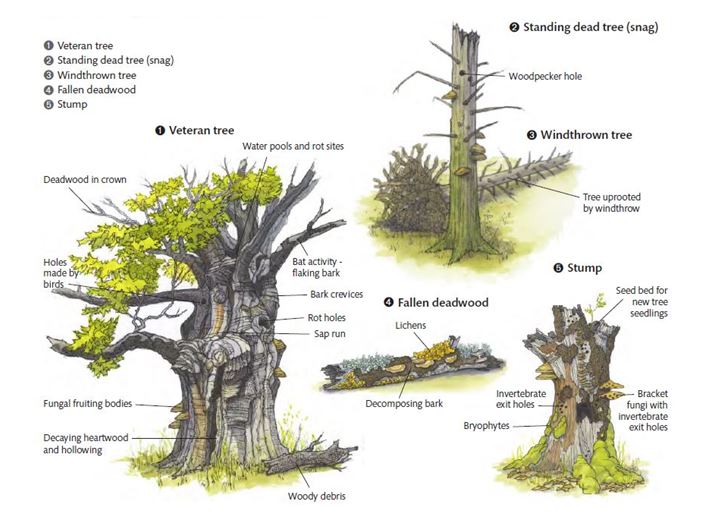
A veteran tree

Shared for the beauty of the illustration.
The Dead Good Deadwood Blog: What’s so good about deadwood? - TCV Scotland http://buff.ly/2iACbiW

types-of-dw
Photo

What the heck is all this garbage?

There once was a social media platform called Google Plus, or G+. It had a very different flavor from other social media: it was a platform ...